

Nigerian schools are rapidly embracing digital transformation, moving away from traditional record-keeping methods toward comprehensive school management platforms that streamline operations. With the education technology market expanding across Lagos, Abuja, Port Harcourt, and beyond, choosing the right school management system in Nigeria has become crucial for institutions seeking operational excellence. This complete guide walks you through everything you need to know about selecting a platform that fits your school’s unique needs in 2025.
Understanding School Management Platforms in the Nigerian Context
What is a School Management Platform?
A school management platform is an integrated digital solution that automates and centralizes all administrative, academic, and communication functions within an educational institution. Unlike standalone tools, modern platforms combine student information systems, learning management capabilities, and operational workflows into one cohesive ecosystem.
For Nigerian schools, understanding what a school management system truly offers is the first step toward making an informed choice. These platforms address specific challenges like manual attendance recording, delayed fee collection, limited parent-teacher communication, and fragmented academic tracking that plague many institutions.
Why Nigerian Schools Need Digital Management Systems
The Nigerian education landscape faces unique operational challenges. Teachers spend countless hours on manual attendance tracking, administrators struggle with paper-based record keeping, and parents remain disconnected from their children’s daily academic progress. Traditional methods cannot scale with growing student populations or meet modern expectations for transparency and accessibility.
The evolution of school management systems in Nigeria shows how institutions are moving toward solutions that handle everything from admissions and fee management to CBT exams preparation for WAEC, NECO, and GCE. Digital transformation is no longer optional—it’s essential for competitive schools.
Essential Features Every School Management Platform Must Have
When evaluating a school management software, certain features are non-negotiable. Modern school management systems should include:
1. Comprehensive Academic Management
Student Information System: Centralized database storing student profiles, medical records, emergency contacts, and enrollment history.
Online Grading System: Automated grade calculations, report card generation, and performance tracking that eliminates manual computation errors.
Timetable Management: Digital scheduling for classes, teachers, and facilities that prevents conflicts and maximizes resource utilization.
Assignment and Assessment Tracking: Teachers can create, distribute, and grade assignments digitally while students access materials through a dedicated student portal.
2. Financial Management and Fee Collection
Nigerian schools require robust school fee management systems that handle:
- Multiple payment channels including bank transfers, card payments, and mobile money
- Automated payment reminders and receipts
- Fee structure customization for different grades and programs
- Real-time financial reporting and reconciliation
Effective fee collection through digital platforms reduces revenue leakage and improves cash flow predictability for school administrators.
3. Attendance and Behavioral Tracking
Digital attendance tracking transforms how Nigerian schools monitor student presence. Instead of time-consuming paper registers, teachers record attendance in seconds through mobile apps or web interfaces. The system generates:
- Real-time attendance reports accessible to parents
- Automated absence notifications via SMS or app alerts
- Attendance trend analysis for identifying patterns
- Integration with disciplinary and behavioral tracking
4. Communication and Engagement Tools
Strong parent-teacher communication remains fundamental to student success. Your school management platform should enable:
Parent Portal: Secure access to grades, attendance, fee statements, and school announcements
Direct Messaging: Private communication channels between teachers and parents
Broadcast Notifications: School-wide announcements for events, emergencies, or policy changes
Teacher Collaboration: Internal messaging and resource sharing among staff members
5. Learning and E-Learning Integration
With blended learning becoming standard, platforms must support online learning through:
- Digital lesson delivery and content libraries
- CBT exams platform for practice tests
- Past question databases for WAEC, NECO, and GCE preparation
- Quiz creation and automated assessment tools
- Virtual classroom capabilities for remote learning
6. Administrative and HR Functions
School ERP software components should include:
- Staff records and payroll management
- Leave and attendance tracking for teachers
- Document management and contract storage
- Recruitment and on-boarding workflows
- Performance evaluation systems
Comparing Manual vs Digital School Management Systems
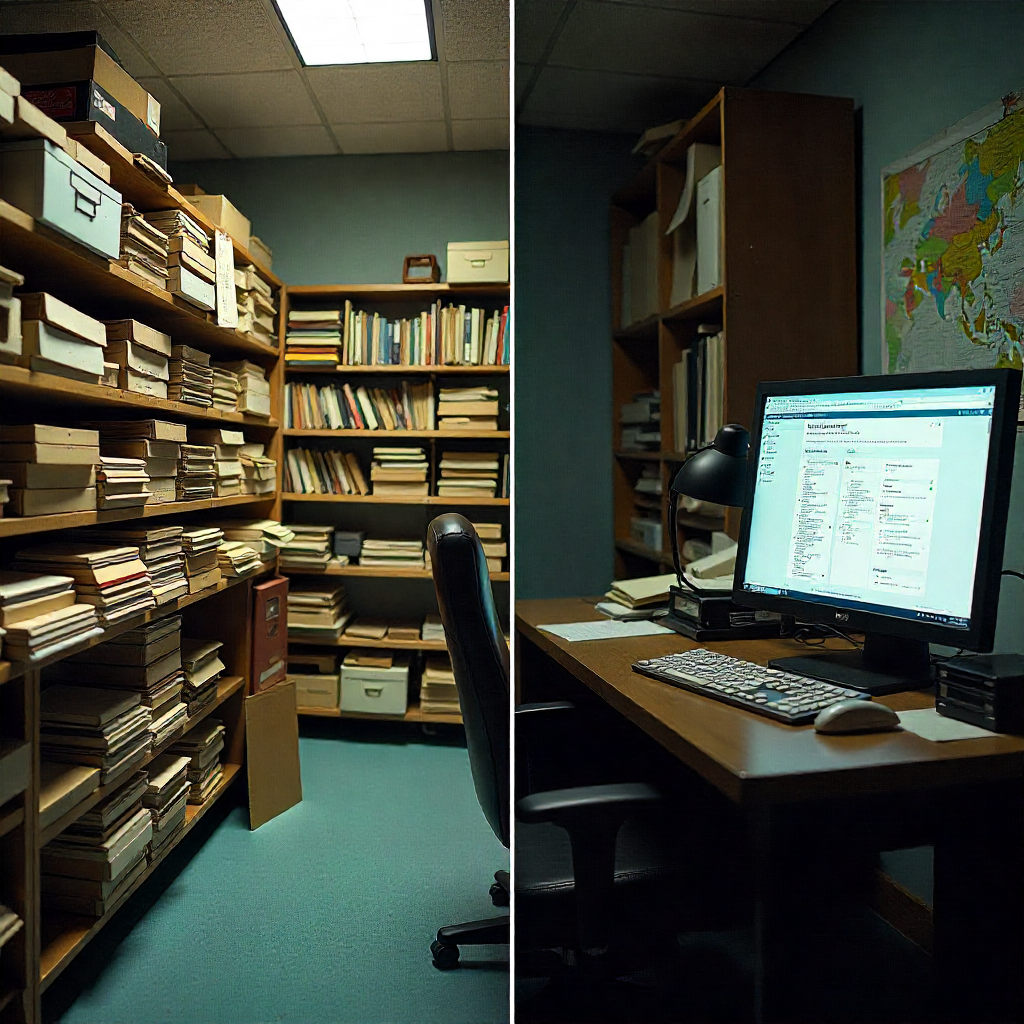
The difference between manual and digital school management is stark when you examine operational efficiency. Manual systems create bottlenecks: teachers waste valuable instruction time on paperwork, administrators cannot access real-time data for decision-making, and parents feel disconnected from their children’s education.
Manual vs Digital: Side-by-Side Comparison
| Aspect | Manual System | Digital School Management Platform |
|---|---|---|
| Attendance Tracking | 15-20 minutes per class using paper registers | 30 seconds using mobile app or web interface |
| Grade Calculation | Hours of manual computation with error risk | Automated calculation with instant results |
| Parent Communication | Phone calls, paper notices (slow, limited reach) | Instant SMS, app notifications, direct messaging |
| Fee Collection | Cash handling, manual receipts, reconciliation delays | Online payments, automated reminders, real-time tracking |
| Report Card Generation | Days or weeks of manual data entry and printing | Minutes with automated generation and digital delivery |
| Data Access | Physical file retrieval, office hours only | 24/7 access from anywhere via web or mobile |
| Record Storage | Physical space, vulnerable to damage/loss | Cloud storage with automatic backups |
| Cost per Student/Year | ₦3,000-5,000 (paper, printing, storage, staff time) | ₦500-2,000 (software subscription) |

Digital platforms eliminate these friction points. Teachers reclaim hours previously spent on administrative tasks, significantly improving teacher efficiency and allowing them to focus on instruction quality. Parents receive instant updates and can engage proactively with their child’s academic journey.
How School Management Platforms Enhance Student Performance
Research shows that schools using management platforms see measurable improvements in student outcomes. The mechanisms are clear:
Student Performance Impact: Year-Over-Year Analysis
Graph: Student Performance Improvement After Platform Implementation

Percentage Improvement (%)
        |
    25% |                                    ●
        |                          ●
    20% |                ●
        |      ●
    15% |  ●
        |
    10% |
        |
     5% |
        |
     0% |_____|_____|_____|_____|_____|
          Y1    Y2    Y3    Y4    Y5

Legend:
● Average Grade Improvement
Y1 = First Year | Y5 = Fifth Year
Data based on Nigerian schools using school management platforms

Key Findings:
- Year 1: 12% improvement in average grades
- Year 2: 18% improvement (as teachers master platform)
- Year 3: 21% improvement (full adoption)
- Year 4: 23% improvement (optimized workflows)
- Year 5: 24% improvement (sustained excellence)

Data-Driven Interventions: Teachers identify struggling students early through performance analytics and provide targeted support before issues compound.
Increased Parental Involvement: When parents access real-time academic data, they engage more actively in their children’s education, reinforcing school efforts at home.
Consistent Monitoring: Continuous tracking of assignments, assessments, and attendance creates accountability and helps students stay on track.
Personalized Learning: Digital platforms enable differentiated instruction by tracking individual student progress and learning patterns.
Understanding these performance enhancement mechanisms helps school leaders justify investment in digital infrastructure.
Why Parents Prefer Schools with Digital Management Systems
Enrollment decisions increasingly factor in technological infrastructure. Parents actively seek schools with robust management systems because these platforms provide transparency, convenience, and engagement opportunities that traditional schools cannot match.
Modern parents expect:
- Real-time visibility into their child’s academic performance
- Convenient online fee payment options
- Direct communication channels with teachers
- Mobile access to school information anytime, anywhere
- Security features like bus tracking with geo-location
Schools that offer these capabilities position themselves as forward-thinking institutions committed to educational excellence and family partnership.
Key Factors to Consider When Choosing a School Management Platform
1. Scalability and Flexibility
Your chosen school management system must grow with your institution. Consider:
- Can it handle increasing student enrollments?
- Does it support multiple campuses or branches?
- Can features be enabled or disabled based on needs?
- Is the pricing model sustainable as you scale?
2. User Experience and Adoption
The most feature-rich platform fails if teachers, administrators, and parents find it confusing. Evaluate:
- Interface intuitiveness for non-technical users
- Mobile app availability and functionality
- Training and support resources provided
- Adoption success rates at similar schools
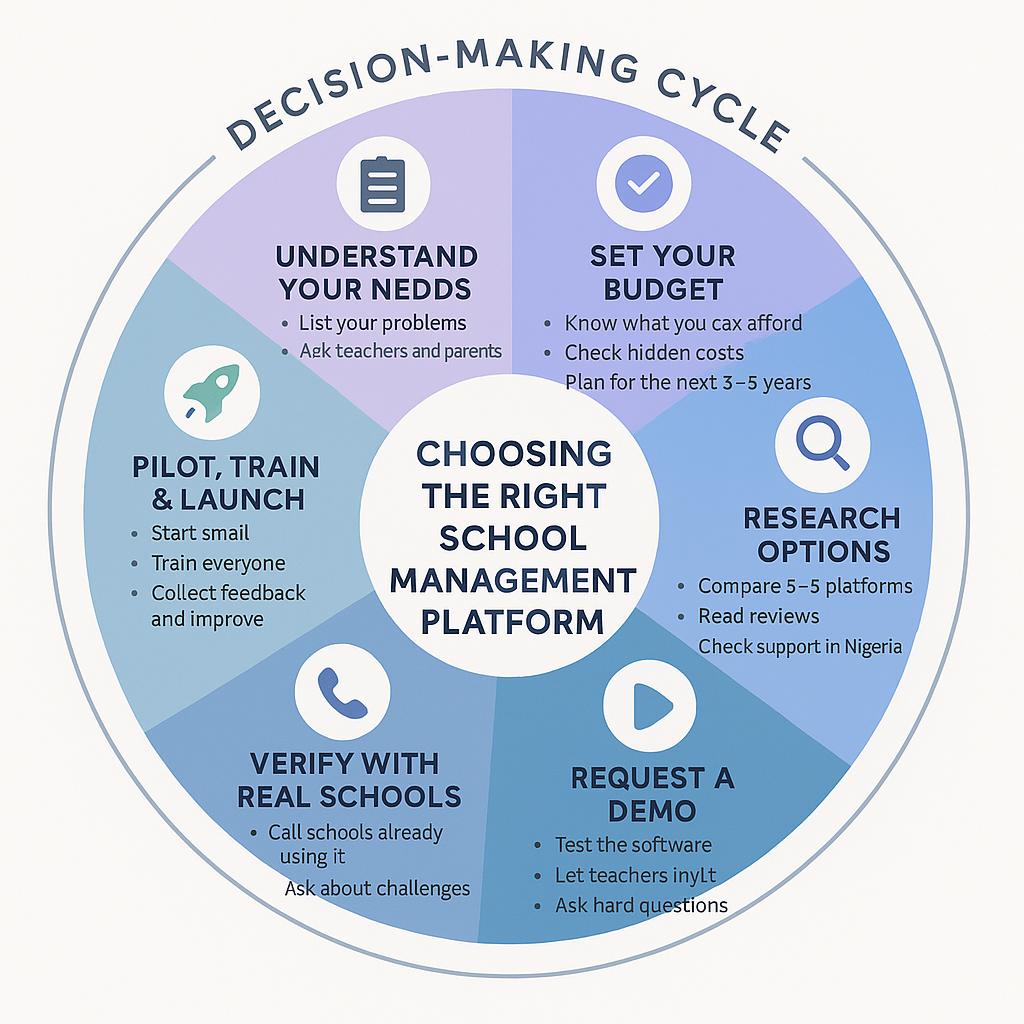
Platform Selection Decision Framework
╔════════════════════════════════════════════════════════════════╗
║        INFOGRAPHIC: 6-STEP PLATFORM SELECTION PROCESS          ║
╚════════════════════════════════════════════════════════════════╝

    ┌─────────────────┐
    │   STEP 1:       │
    │  ASSESS NEEDS   │──── ✓ Identify pain points
    └────────┬────────┘     ✓ Survey stakeholders
             │              ✓ Define must-have features
             ▼
    ┌─────────────────┐
    │   STEP 2:       │
    │ SET BUDGET      │──── ✓ Calculate TCO
    └────────┬────────┘     ✓ Consider hidden costs
             │              ✓ Plan for 3-5 years
             ▼
    ┌─────────────────┐
    │   STEP 3:       │
    │ RESEARCH        │──── ✓ Compare 3-5 platforms
    └────────┬────────┘     ✓ Read reviews
             │              ✓ Check local support
             ▼
    ┌─────────────────┐
    │   STEP 4:       │
    │ REQUEST DEMOS   │──── ✓ Test user interface
    └────────┬────────┘     ✓ Ask tough questions
             │              ✓ Involve end-users
             ▼
    ┌─────────────────┐
    │   STEP 5:       │
    │ VERIFY          │──── ✓ Call references
    └────────┬────────┘     ✓ Visit schools using it
             │              ✓ Check track record
             ▼
    ┌─────────────────┐
    │   STEP 6:       │
    │ PILOT & DEPLOY  │──── ✓ Start small
    └─────────────────┘     ✓ Train thoroughly
                            ✓ Gather feedback

SUCCESS FACTORS:
• Executive buy-in (90% importance)
• Adequate training (85% importance)
• User involvement in selection (80% importance)
• Clear implementation timeline (75% importance)
Your platform shouldn’t exist in isolation. Check for:
- Integration with accounting software
- Compatibility with existing hardware (fingerprint scanners, card readers)
- API availability for custom integrations
- Data import/export capabilities
4. Security and Data Privacy
Nigerian schools handle sensitive student and family information. Ensure:
- Data encryption in transit and at rest
- Role-based access controls
- Regular security audits and updates
- Compliance with data protection standards
- Reliable backup and disaster recovery systems
5. Local Support and Reliability
Cloud-based vs on-premise deployment is an important consideration, but equally critical is:
- Availability of local technical support in Nigeria
- System uptime and reliability track record
- Internet dependency and offline capabilities
- Response times for issue resolution
6. Cost and Value Proposition
Beyond sticker price, evaluate total cost of ownership:
- Implementation and setup fees
- Per-student or flat-rate pricing models
- Training and onboarding costs
- Ongoing support and maintenance fees
- Hidden costs for additional features or users
Understanding the true cost of school management software helps you budget appropriately and avoid surprises.
Implementation Challenges and How to Overcome Them
Digitization challenges in Nigerian schools are real but surmountable. Common obstacles include:
Resistance to Change: Address this through comprehensive stakeholder engagement, demonstrating clear benefits, and involving teachers in the selection process.
Limited Technical Skills: Effective training programs and ongoing support ensure all users gain confidence with new systems.
Budget Constraints: Start with core modules and expand incrementally. Many providers offer flexible payment plans.
Infrastructure Limitations: Choose platforms with offline capabilities and modest internet requirements.
Successful implementation strategies involve phased rollouts, pilot programs, and continuous feedback loops that allow schools to adjust based on real-world experience.
Top School Management Platforms in Nigeria (2025)
The Nigerian market offers several quality options. Comparing the top 10 platforms reveals significant variation in features, pricing, and support quality.
Excel Mind: Comprehensive Solution for Nigerian Schools
Excel Mind stands out as a best school management system for Nigerian schools by offering:
Excel Mind Feature Overview
╔═══════════════════════════════════════════════════════════════╗
║              INFOGRAPHIC: EXCEL MIND PLATFORM ECOSYSTEM        ║
╚═══════════════════════════════════════════════════════════════╝

                    ┌─────────────────────┐
                    │   EXCEL MIND        │
                    │   CENTRAL HUB       │
                    └──────────┬──────────┘
                               │
         ┌─────────────────────┼─────────────────────┐
         │                     │                     │
    ┌────▼─────┐         ┌────▼─────┐         ┌────▼─────┐
    │ PARENTS  │         │ TEACHERS │         │  ADMIN   │
    │ STUDENTS │         │  STAFF   │         │ MANAGERS │
    └────┬─────┘         └────┬─────┘         └────┬─────┘
         │                    │                     │
    ┌────▼─────────────┐ ┌───▼──────────────┐ ┌───▼──────────────┐
    │ • Grade Access   │ │ • Attendance     │ │ • Fee Management │
    │ • Fee Payments   │ │ • Lesson Plans   │ │ • Payroll        │
    │ • Attendance     │ │ • Assessments    │ │ • HR Records     │
    │ • Bus Tracking   │ │ • Communication  │ │ • Analytics      │
    │ • CBT Practice   │ │ • Grading Tools  │ │ • Reports        │
    │ • Messaging      │ │ • Resources      │ │ • Website        │
    └──────────────────┘ └──────────────────┘ └──────────────────┘

KEY DIFFERENTIATORS:

✓ WAEC/NECO/GCE Past Questions Library
✓ Real-time Bus Tracking with Geo-location
✓ Fully Mobile-Responsive Design
✓ Offline Capability for Poor Connectivity
✓ Nigerian Naira Payment Integration
✓ Local Language Support (Coming Soon)

AVAILABLE ON:
[Web] [Android] [iOS] [Desktop]
For Parents and Students:
- Academic and attendance tracking with instant access to grades and performance trends
- Secure online fee payments with automated reminders and digital receipts
- Real-time notifications for exams, events, and announcements
- Bus tracking with geo-location for safety and convenience
- Direct messaging with teachers for questions and meeting scheduling
- Timetable and assignment tracking accessible anytime
- Comprehensive e-learning platform with study tools
- CBT exams platform featuring WAEC, NECO, and GCE past questions
- Real-time results and feedback on academic progress
For Teachers:
- Digital attendance recording completed in seconds
- Streamlined assignments, grading, and assessments with auto-calculation
- Lesson planning and curriculum management tools
- Instant communication channels with parents and students
- Classroom feed for sharing announcements, notes, and multimedia content
For School Administrators:
- Complete admissions and fee management system
- Real-time attendance data for students and staff
- HR, payroll, and document management capabilities
- Professional school website with geo-location integration
- Comprehensive data dashboards and financial reports
Comparing Excel Mind with other platforms demonstrates its superior value proposition for Nigerian institutions seeking comprehensive functionality without complexity.
Real Success Stories: Nigerian Schools Transformed
Case studies of schools that have implemented management platforms reveal consistent patterns:
Impact Metrics: Before and After Digital Transformation
| Performance Indicator | Before Platform | After Platform | Improvement |
|---|---|---|---|
| Administrative Hours/Week | 25-30 hours | 10-12 hours | 50-60% reduction |
| Fee Collection Rate | 65-75% | 90-95% | +25 percentage points |
| Parent Engagement Score | 3.2/10 | 8.5/10 | 165% increase |
| Teacher Satisfaction | 6.1/10 | 8.9/10 | 46% improvement |
| Student Performance | 62% average | 74% average | +12 percentage points |
| Report Card Generation Time | 3-4 weeks | 2-3 days | 90% faster |
| Parent Communication Reach | 40% of parents | 95% of parents | +55 percentage points |
Lagos Private School (850 students):
- Reduced fee collection time from 6 weeks to 2 weeks
- Eliminated 80% of parent complaint calls
- Teachers report 3+ hours saved weekly on administrative tasks
Abuja Secondary School (1,200 students):
- Improved attendance monitoring accuracy from 75% to 99%
- Increased parental engagement in school events by 60%
- Achieved 95% on-time fee payment rate
Port Harcourt Academy (600 students):
- Reduced report card production from 4 weeks to 48 hours
- Enabled remote learning during infrastructure disruptions
- Streamlined admission process from 2 weeks to 3 days

These transformations occur across diverse institutional types, from small private schools to large multi-campus systems.
Making Your Final Decision: A Practical Framework
Choosing the best platform for your school requires systematic evaluation:
Step 1: Define Requirements Document your school’s specific needs, pain points, and priorities. Involve all stakeholders in this process.
Step 2: Research Options Create a shortlist of platforms that serve Nigerian schools successfully. Review comparative analyses to understand market leaders.
Step 3: Request Demonstrations See platforms in action. Test user interfaces, ask questions about scenarios specific to your school, and gauge vendor responsiveness.
Step 4: Check References Speak with schools currently using your shortlisted platforms. Ask about implementation experiences, ongoing support quality, and unexpected challenges.
Step 5: Pilot Before Full Deployment If possible, run a pilot program with one grade level or department to identify issues before school-wide rollout.
Step 6: Plan Comprehensive Training Budget adequate time and resources for training all user groups. Success depends on adoption, which requires confidence and competence.
The Future of School Management Platforms in Nigeria
Looking ahead to 2025 and beyond, expect platforms to incorporate:
Technology Adoption Timeline (2025-2030)
📊 Graph: Emerging Technologies in School Management Platforms

Adoption Rate (%)
        |
   100% |                                              ◆
        |                                        ◆
    80% |                                  ◆
        |                            ■
    60% |                      ■
        |                ●
    40% |          ●
        |    ▲
    20% |▲
        |
     0% |_____|_____|_____|_____|_____|_____|
         2025  2026  2027  2028  2029  2030

Legend:
▲ Mobile-First Design (Currently 22%, Target 95%)
● AI-Powered Analytics (Currently 15%, Target 75%)
■ Blockchain Credentials (Currently 5%, Target 65%)
◆ Predictive Learning Systems (Currently 3%, Target 85%)

Adoption Stages:
Early Adopters → Growth → Maturity → Universal
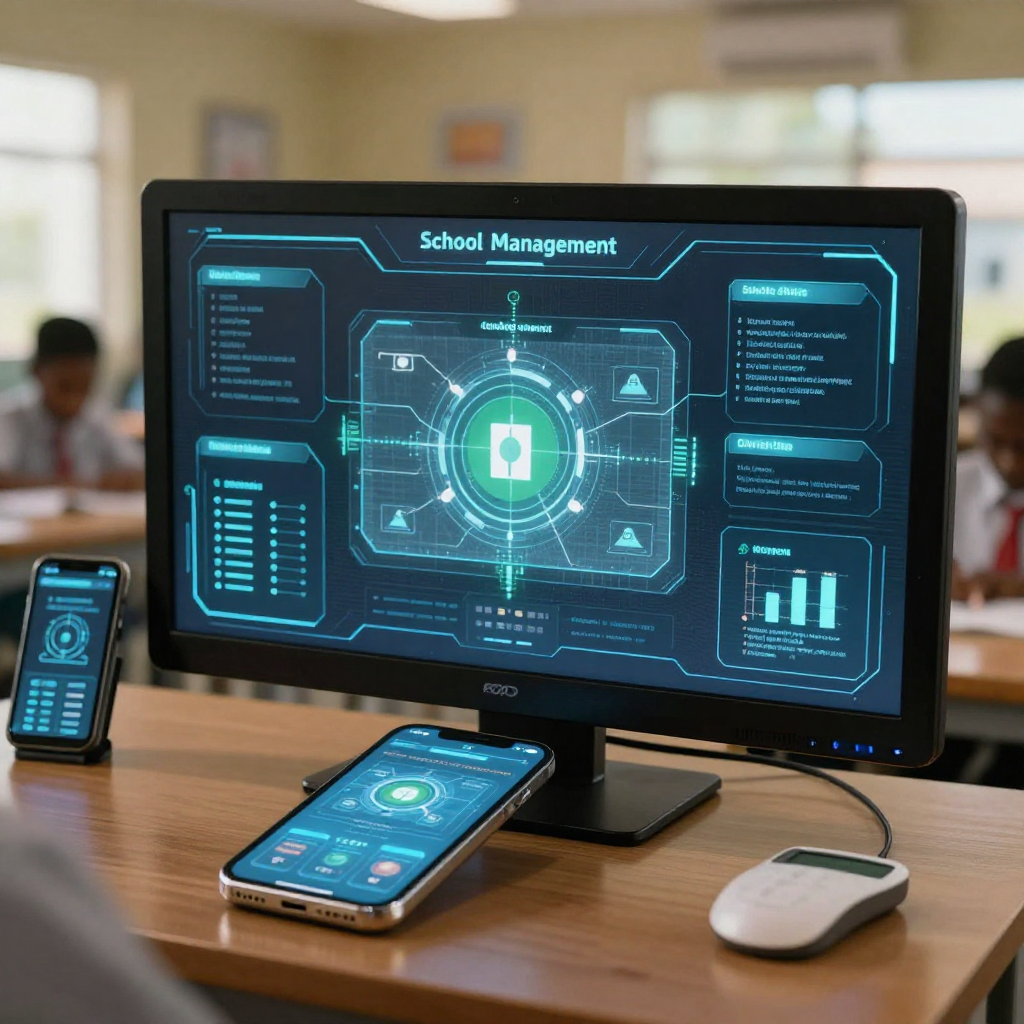
- Artificial Intelligence: Predictive analytics for student performance, automated administrative tasks, and personalized learning recommendations
- Advanced Analytics: Sophisticated data visualization and benchmarking capabilities
- Enhanced Mobile Functionality: Full platform access through smartphones for users across Nigeria
- Integration with Educational Content: Seamless connection between management and learning resources
- Blockchain for Credentials: Secure, verifiable academic records and certificates
Schools that adopt robust platforms now position themselves to leverage these innovations as they emerge.
Key Takeaways
- School management platforms are essential for modern Nigerian schools seeking operational excellence and improved student outcomes
- Successful platforms must address local challenges including fee collection, attendance tracking, and parent communication
- Essential features include academic management, financial tools, attendance tracking, communication systems, e-learning integration, and HR capabilities
- Implementation requires careful planning, stakeholder buy-in, and comprehensive training
- Total cost of ownership extends beyond licensing fees to include implementation, training, and ongoing support
- Excel Mind offers comprehensive functionality specifically designed for Nigerian schools, with features supporting parents, students, teachers, and administrators
Frequently Asked Questions
Q: What is the best school management system for private schools in Nigeria?
The best school management platform depends on your specific needs, but look for solutions offering comprehensive academic tracking, flexible fee management, strong parent communication tools, and local support. Excel Mind provides all these features with a proven track record in Nigerian private schools, including CBT exam preparation and bus tracking capabilities that parents value.
Q: How much does school management software cost in Nigeria?
Pricing varies significantly based on student enrollment, feature requirements, and deployment model. Most providers offer per-student pricing ranging from ₦500 to ₦2,000 annually, though some use flat-rate institutional licensing. Understanding the full cost structure including implementation and training helps you budget accurately. Request detailed quotes and compare total cost of ownership rather than just licensing fees.
Q: Can a school management system work with poor internet connectivity?
Many modern school management systems offer offline capabilities for critical functions like attendance recording and grade entry. Data syncs automatically when connectivity returns. Cloud versus on-premise considerations affect internet dependency, with hybrid solutions offering the best of both worlds for Nigerian schools facing infrastructure challenges.
Q: How long does it take to implement a school management platform?
Implementation timelines typically range from 2-8 weeks depending on school size, data migration complexity, and customization requirements. Critical success factors include thorough planning, adequate training time, and phased rollouts that allow users to adapt gradually. Starting during academic breaks minimizes disruption to regular operations.
Conclusion
Choosing the right school management platform represents one of the most impactful decisions Nigerian school leaders will make in 2025. The right system transforms operational efficiency, enhances student outcomes, improves parent satisfaction, and positions your institution as a forward-thinking educational leader.
Excel Mind’s comprehensive school management software is purpose-built for Nigerian schools, addressing local challenges while providing world-class functionality. From digital attendance tracking and secure fee payments to CBT exam preparation and bus tracking with geo-location, Excel Mind empowers every stakeholder in your school community.
Ready to transform your school’s operations? Request a free demo of Excel Mind today and discover how the right school management system in Nigeria can revolutionize your institution’s efficiency and educational excellence.